Photo:Ghost Crabs (Ocypode sp.) of Chennai are facing a new threat. Commercial hunting and export for preparation of medicinal products. Location: Elliot's beach, Besant Nagar, Chennai.
Been to Marina or Elliots or any other beach in Chennai? Then, you must have surely spotted these guys. With alien like eye stalk and swift like agility, they keep shuttling back and forth, radiating around their tiny burrows which is their home. That is why they are called "Ghost Crabs".
Ghost Crabs, breathe through their gills and stay in their burrows when conditions are unfavorable, such as heat (afternoons), anthropogenic disturbance and cold spells (winter days). They usually feed during morning and evening hours of the day. Their food comprises for organic matters and sometime they even prey on baby sea turtles. I'm highly skeptical about these crabs ingesting plastics/debris or even microplastics for that matter.
Next time when you go to the beach, take time to observe these magnificent alien like life. When you start connecting with them, it transforms into an amazing experience. Just give it a try!
Death of a whale, commonly known as a Whale Fall creates a whole new micro niche at the place where it settles down. Here is a short video explaining the whole phenomenon.
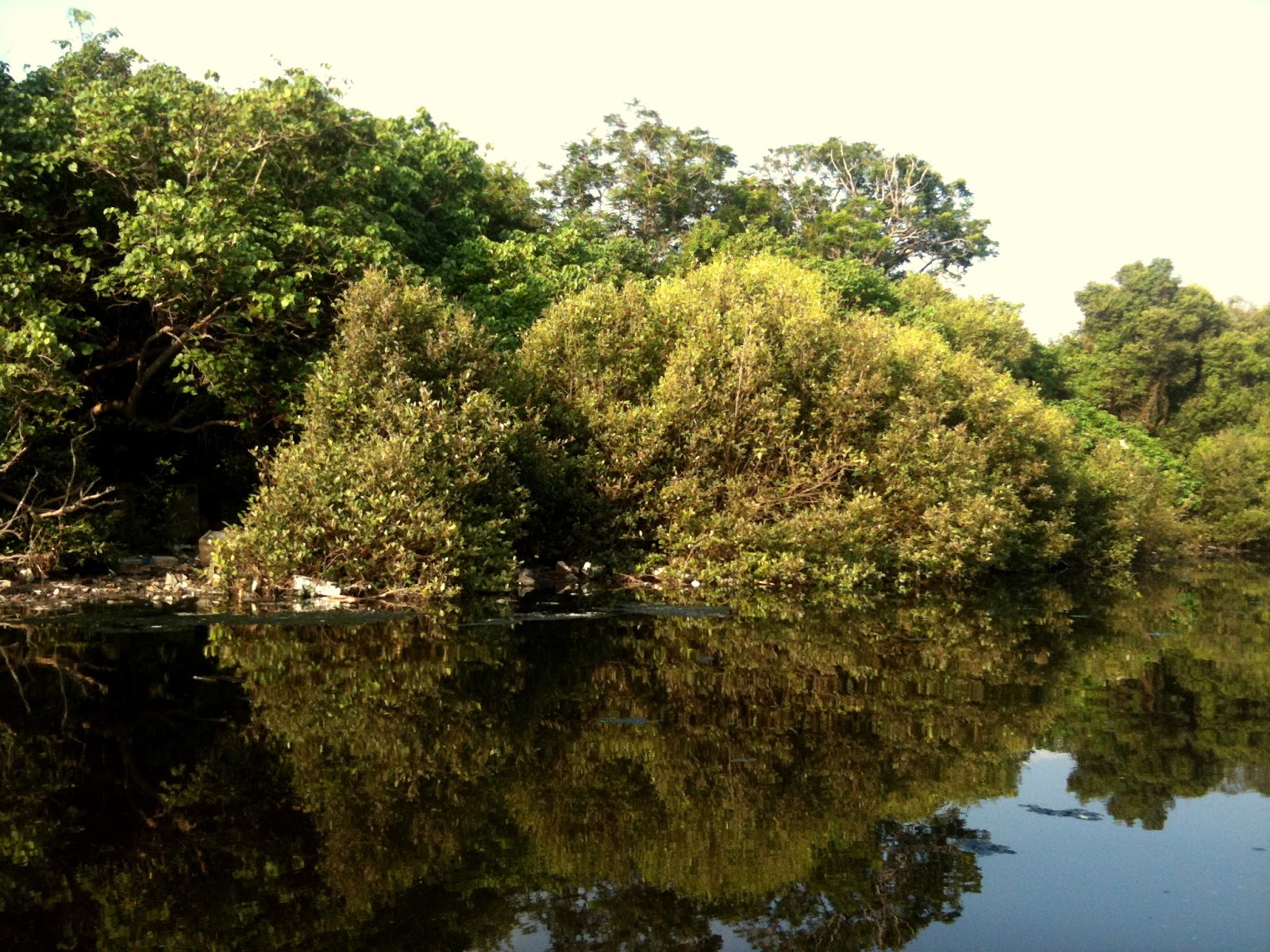
It was a Sunday morning in the month of April, 2011. Walking through the ipomoea matted roads with the sun on my face, felt so relaxing. I was walking to the Broken Bridge (500m from Elliots beach), where the sea meets the river, where the mangrove babies struggle their way out of the earth. Myself and few of my friends from Reclaim Our Beaches decided to visit the mangrove island down the river, where huge mangrove forest exist in secrecy from the city's atmosphere. A walk down the bridge showed me the degradation that the estuary has undergone. Dead fishes floating in the river, few were gasping for their last breath of air and fishermen collecting these fishes in the nets and transporting them to market. It was an awful sight. Couldn't do much!
Mangrove Forest, Adyar Esturay. Photo: Sid Hande
We had hired a Catamaran to wade through the murky black waters of the Adyar river. Myself and my friend Sid Hande were the lucky two who made it on the boat. More than that and the boat would topple. Getting on to the catamaran and balancing ourselves needed some knack. And traveling for the first time in the estuary where I never would have even imagined, was an experience in itself. We had few crab friends as they hitched a ride with us tickling our foot and resting on our slippers.
Distant shot of Broken Bridge. Photo: Sid Hande
First few meters into the river and we were already amazed by looking at the mangroves surviving in the banks of the river. I was asking myself whether I'm in Chennai or some where else on earth. Moving closer to the islands, I was silently contemplating of how the estuary might have looked few decades ago when it was pristine. My vision was spilling all over. Addition to that Saravanan (fisherman/activist), our friend was telling joyous childhood stories of how he would come to catch shrimps in the estuary and silently sink into the lush mangrove forests. The boatman was telling his own stories of how he survived with group of friends, 18 days lost in the sea and finally found by the Indian Navy.
The boat ride was a revealing journey. Certainly it disproved my ideas about mangrove ecosystems in the city. Our initial ideas were to conserve the baby mangroves which grow near the Broken Bridge, but this boat ride threw light upon the existing biodiversity and the challenges faced by these mangrove forest. Once pristine, now these mangrove islands are flooded with Styrofoam, plastics and what not. This clearly shows waste mis-management practices in Chennai city. Even the uninhabited and isolated islands are victims of our ever growing trash culture.
While trying to look out for solutions, I stop and ponder whether have I been asking the right questions.
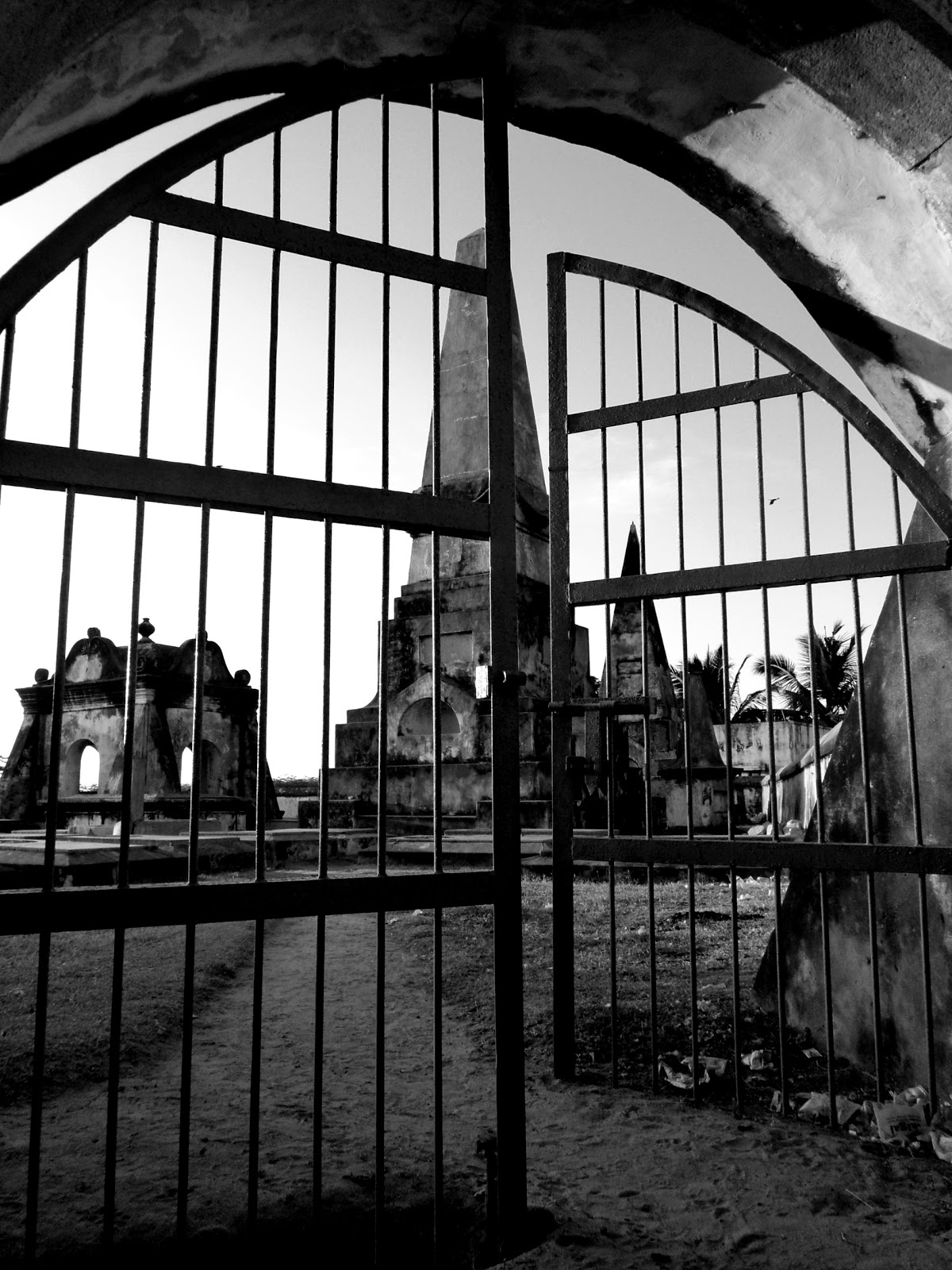
This monument has gone around the sun 372 times and it still mourns for the dead, for the deceased and holds many stories to itself. These are photos from the Dutch cemetery, located at Pulicat Lake near Chennai. The Dutch were the first settlers at Pulicat using the lake as a means to navigate and transport goods. There are stories of outbreak of epidemics during the late 1600's which caused many deaths in the town which included babies and children. This cemetery stands as a remembrance of the lost souls, kings and queens, soldiers and diplomats, the rich and the poor.
From pristine habitats to polluted sinks, our oceans has it all. While our knowledge about the oceans is evolving, there also seems to be a collective amnesia which makes humanity forget what is being done and what changes the oceans have encountered. This is what scientists call shifting environmental baselines. Commonly known as shifting baseline syndrome.
In his latest book "The Unnatural History of the Sea", Prof. Callum Roberts explains the phenomenon which is easy to understand. He states "The idea of shifting baselines is familiar to us all and does not just relate to the natural environment. It helps explain why people tolerate the slow crawl of urban sprawl and loss of green space, why they fail to notice increasing noise pollution, and why they put up with longer and longer commutes to work. Changes creep up on us, unnoticed by younger generations who have never known anything different. The young write off old people who rue the losses they have witnessed as either backward or dewy-eyed romantics. But what about the losses that none alive today have seen? In most parts of the world, human impacts on the sea extend back for hundreds of years, sometimes more than a thousand. Nobody alive today has seen the heyday of cod or herring. None has watched sporting groups of sperm whales five hundred strong, or seen alewife run so thick up rivers there seemed more fish than water. The greater part of the decline of many exploited populations happened before anybody alive today was born."
So when these baseline shifts happen, the environment that we live in becomes unpredictable and it takes every organism on the planet to adapt itself to sustain life.That apart, the quality of life degrades too. The present generation is already facing the brunt of our predecessors actions. The next generation, from ours.
These changes happen so subtly, that it is pretty hard to determine the impacts of even the minutest of shifts. If we take the city of Chennai, it is hard to imagine the fact that rich coral reefs and lush mangroves once existed in some of today's popular beaches in the city. When I heard from fishermen about how Chennai looked few decades ago, I literally had to ask them to come over again. What I heard was unbelievable, but true. Madras, as Chennai was formerly known, had rich marine biodiversity as it had been recorded by English scientists when India was under the rule of Britain. This raises the question how and why weren't the resources managed properly. At present, only the remnants of the rich past remains.
According to the laws of nature, change is inevitable. Determining the changes for good or to its worse is in no one else's, but our hands.
Lets embrace changes and also make sure that the changes are for good.
"There is a pleasure in the pathless woods,
There is a rapture on the lonely shore,
There is society, where none intrudes,By the deep sea, and music in its roar:
I love not man the less, but Nature more."
~Lord Byron, Childe Harold's Pilgrimage
They were unknown, they were unexplored, territories uncharted but in the past. Welcome to the new era of technology which makes everything possible. Well, it can be used both for constructive as well as destructive purposes.
Experiments and surveys in the deep blue oceans are considered a challenge, always. Reasons are many. Explorations in the past have resulted in dire consequences. In the present day world, technology plays a very important role. SONAR, ROV's , submersibles and what not, to carry out work with precision and perfection. A decade of study carried out by Census of Marine Life portrayed scenes beyond our wildest dreams, threw light on the exceptional environments and organisms in the oceans. And this was solely possible with the help of sophisticated technology.
Humans are certainly exploring the unknown and lets hope the rest is all for good.
Couldn't resist sharing this on my website. Sincere thanks to my friend Julia Whitty for posting this on her blog DEEP BLUE HOME. This beautiful video never fails to inspire me and pushes me to go beyond.